There is no God, child. There’s religion but there’s no God of theirs. Their religion tells that we will get our reward in the end. However, it apparently doesn’t say anything about their punishment. But when we’re around them, we believe in God. Oh, Lawdy Lawd, we’s be believin’. Religion is just a controlling tool they employ and adhere to when convenient
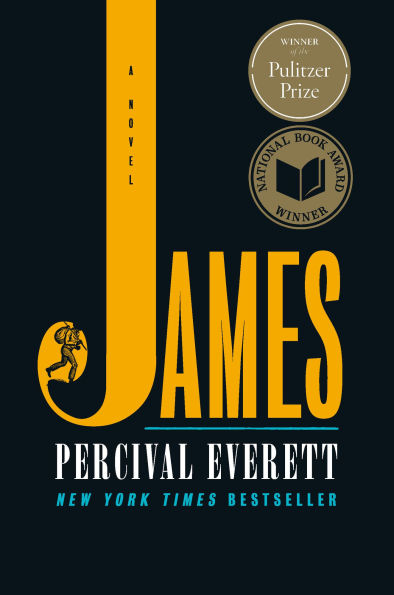
At the time of writing this, Percival Everett’s novel James was published exactly two years ago. Since then, the book has experienced immense success, to the point where I felt late to the party when I began reading it a month ago. Besides being a bestseller, the novel also won the National Book Award and Pulitzer Prize, and made the shortlist for the Booker Prize. With a Steven Spielberg-produced adaptation now in the works, it’s hard to think of another recent book that immediately established itself upon impact as James did. This success was top of mind when I began reading, and it was both a source of excitement and something I needed to keep in check before high expectations got the better of me. And while high expectations have turned into bigger disappointments for me in the past, it became clear immediately that James has more than earned its reputation.
The novel is a retelling of Mark Twain’s Huckleberry Finn from Jim’s perspective. In both texts, Jim is a slave “belonging” to Miss Watson. She sells his wife and children, and at risk of being separated from his family forever, Jim escapes. This act coincides with Huck’s own decision to flee home after his drunk, abusive father reenters his life. Together, the two embark on a series of adventures across America.
The question of whether a person can enjoy James without having read Huckleberry Finn is important. Before delving into that, I should state my belief that all fiction in conversation with another piece of literature should be able to stand on its own. Percival Everett, being a strong writer, has fulfilled that basic obligation. You can experience this novel without having read Twain and still find narrative fulfillment. However, I do believe that reading Huckleberry Finn before James adds an extra layer of context that cannot be replicated through other means. Twain’s novel remains highly controversial despite its status as a classic. Whether it’s appropriate to teach in middle school or high school is worth discussing. But outside of that conversation, I find it interesting to dissect through the lens of both American history and American literature. And while I personally find the text more nuanced than its critics give it credit for, there are undeniable gaps in Twain’s scope despite its clear anti-racist intent. A common criticism of the original novel is the depiction of Jim. On the one hand, Jim’s compassion and surrogate fatherhood towards Huck serve as a counterpoint to the hypocrisy of white Christian society at the time. However, that same loyalty can also be read as subservient to the detriment of Jim’s emotional depth. The novel is also not above portraying him as superstitious, and his dialogue is written in a stereotypical slave dialect. In James, slaves knowingly speak in the same dialect around white people to undermine their intelligence as a means of survival. When they’re together, they drop it and speak normally. This choice is one example of why Huckleberry Finn is the best aid to appreciating James. It takes an antiquated quality from the original text and reimagines it in a way that reframes the intelligence and cleverness of the oppressed.
Despite using words like “reimagine” and “retelling” throughout this post, it should be stated that Percival Everett doesn’t view his book in those terms. In an interview for Elle, he states that James, “Addresses what Mark Twain would not have been able to address.” He further states, “I hope that no one thinks that my novel is about slavery.” The distinction being that the novel’s protagonist is enslaved, but slavery as an institution is not the overall focus. My view from this admission is that both novels use the protagonists’ journey and its episodic nature as a panoramic snapshot of the country. I also find perspective to be an inherent theme in the work. James’ plot deviates from Huckleberry Finn’s around the halfway point, but even when they align, Everett’s novel consistently highlights how perilous James’ situation is. For him, capture means death, and it would almost certainly be an agonizing one, with the threat of lynching looming over his movements. This adds to the prevalent theme in both texts, which is claiming autonomy in a corrupt society. Huck’s resolve to help Jim escape slavery in the novel’s closing chapters represents the completion of his character arc. It’s the moment where he breaks free from society’s racist conditioning in favor of his own beliefs and instincts. This theme of autonomy is also written into James, but is refitted to meet the needs of its titular character, who inhabits a completely different role in society. For James, this means recording his experience in the written word to combat the nation’s script surrounding his identity. The natural conclusion is a new ending that perfectly concludes a brilliant novel.
 Literary Gems